E-commerce SEO in 2025 is no longer about sprinkling keywords and fixing a few title tags. Direct-to-consumer (D2C) brands are operating in a landscape where paid acquisition is expensive, attribution windows are shorter, and competition has exploded across every category. In this environment, brands that rely only on Google Ads, Meta Ads, and marketplaces face unstable growth and margin pressure.
To build predictable growth, modern D2C brands need an organic discovery engine that helps people find the right products, understand the value, and feel confident enough to buy and come back. That means combining strong technical foundations, optimized category and product detail pages, structured data, helpful content, and data-led UX decisions into one system. When done correctly, E-commerce SEO, AEO (AI Search Optimization), and GEO (Geo-intent optimization) work together to turn search demand into recurring revenue.
Google’s latest E-commerce guidelines underline the importance of structured product data, clean site architecture, performance, high-quality product experiences, and a clear URL structure. This guide translates those requirements into a D2C context, showing you how to build a search-led growth system that supports both organic and paid performance. You’ll see how your category pages, PDPs, content, and messaging all connect to one goal: turning discovery into revenue.
Throughout this guide, you’ll find contextual links to deep-dive resources: the PDP Optimization Guide 2025, Category Page SEO Blueprint, Messaging Blueprint 2025, ICP Development Framework 2025, and the Competitive Analysis Framework 2025. Treat this pillar as your master playbook and those guides as your implementation blueprints.
This page is intentionally written for founders, heads of growth, performance marketers, and SEO practitioners inside D2C brands who want a practical, non-fluffy roadmap. If you are responsible for scaling revenue and want SEO, AEO, and GEO to work as a compounding system rather than disconnected tasks, this guide will show you how to architect that system step-by-step.
1. Why E-commerce SEO Is the Primary Growth Lever in 2025
Over the last few years, many D2C brands scaled almost entirely through paid channels. Platforms like Meta and Google made it easy to launch campaigns, test creatives, and reach new audiences. But as acquisition costs increased and privacy regulations tightened targeting, that model became less predictable and often less profitable. E-commerce SEO now plays a central role because it helps brands capture intent without paying for every single click.
Organic search has a unique advantage: it meets users where they already are in their decision journey. Someone searching “best vegan skincare for dry skin” is already problem-aware and actively looking for solutions. If your category page, content, and product experience are aligned with that intent, you don’t just get a click—you get a qualified visitor who is more likely to convert and come back. This is why E-commerce SEO, when built correctly, improves both customer acquisition cost (CAC) and lifetime value (LTV).
Beyond traffic, SEO is deeply connected to brand trust. When your brand appears for relevant head terms, long-tail queries, and “brand + reviews” searches, customers perceive you as more credible. This effect multiplies when your brand is visible in organic results, AI Overviews, product carousels, and shopping modules at the same time. AEO and structured data help you unlock those surfaces, while technical SEO ensures Google can consistently crawl and understand your catalog.
There’s also a direct connection between SEO and profitability. Paid campaigns are rented traffic; SEO is an owned engine. When your categories and PDPs rank, you can rely less on aggressive discounting and hyper-competitive bidding wars. Over time, a strong SEO foundation reduces your reliance on performance marketing spend to hit revenue targets. The most resilient D2C brands in 2025 are the ones that treat E-commerce SEO as a core part of their P&L strategy, not just a marketing channel.
Finally, strong SEO systems improve the performance of other channels. High-quality PDPs and category experiences increase conversion rates from Google Ads, Meta retargeting, email, and influencer traffic. When your landing pages are fast, clear, and trustworthy, every campaign performs better. That is why this guide focuses on SEO as a growth system—one that supports and amplifies everything else you do in acquisition and retention.
2. Understanding Search Intent in D2C Buying Journeys
At the heart of effective E-commerce SEO is an accurate understanding of search intent. Not every keyword is a buying keyword, and not every visitor is ready to purchase. D2C brands that perform well in organic search are the ones that map content, categories, and PDPs directly to how buyers think, research, compare, and decide. This is also where AEO and GEO come into play, because AI-driven and location-aware results reward pages that clearly satisfy the underlying intent.
At the top of the funnel (TOFU), users are exploring problems, solutions, and categories. They might search for “benefits of collagen supplements” or “how to choose running shoes for flat feet.” These searches are not necessarily about your brand yet; they are about understanding options and risks. Here, your blog content, educational guides, and buyer resources matter most. These pages should be written with clarity, depth, and neutral value, not as thin sales pages disguised as advice.
In the middle of the funnel (MOFU), users narrow their options and evaluate potential fits. They search terms like “best vegan skincare products,” “top protein snacks for weight loss,” or “sustainable kids clothing brands in India.” This is where your category pages play a critical role. A high-performing category page not only shows products but also explains who the collection is for, what problems it solves, and how to choose among options. The Category Page SEO Blueprint goes deeper into how to structure these pages.
At the bottom of the funnel (BOFU), search intent is focused on decision and purchase. Users will look for “brand name reviews,” “buy [product] online,” “brand name discount code,” or location-modified terms such as “[brand] serum online India” or “[product] in Mumbai.” These are the searches where your PDPs, dedicated review pages, and brand trust pages must be exceptionally strong. They must answer objections, showcase proof, and make the purchase path frictionless. Use the PDP Optimization Guide 2025 to refine this layer.
A complete E-commerce SEO strategy intentionally targets all three layers—TOFU, MOFU, and BOFU—and connects them with internal links and shared messaging. Blogs and guides introduce problems and solutions, category pages help users navigate options, and PDPs help them commit with confidence. When these pieces are aligned and optimized for AI search as well, you create a journey where users can enter from any stage and still find their way to the right product. That journey is what turns search visibility into reliable revenue.
3. Technical SEO Foundations for Scalable E-commerce Growth
Technical SEO is the invisible foundation that supports every other SEO initiative. Without it, even the best content and PDPs struggle to rank consistently. For D2C brands, technical SEO must account for large product catalogs, frequent changes in inventory, filters and sorting, promotions, and third-party apps. It’s not enough to just fix a few errors in a crawl report; you need a system that scales with your catalog and your growth ambitions.
The first pillar is crawlability and indexation control. Many stores unintentionally create thousands of low-value URLs through faceted navigation, filtered results, session parameters, and internal search pages. Google’s crawlers may waste time on these pages instead of focusing on your most valuable categories and PDPs. You can prevent this by blocking certain URL patterns, using noindex on unimportant or thin pages, and ensuring that your main categories and PDPs are always linked cleanly and prominently from your navigation and internal links.
XML sitemaps play a major role too. For fast-moving catalogs, sitemaps should be updated regularly—daily or weekly for larger stores—so Google can quickly discover new products, collections, and important content. Ensure that sitemaps only include canonical, indexable URLs. Pair this with clean canonical tags on PDPs and category pages so Google understands which URL represents the primary version when duplicates or variations exist. The Website Audit in 60 Minutes Guide can help you quickly spot misalignments here.
The second pillar is performance and Core Web Vitals. D2C experiences are often image-heavy and script-heavy due to reviews, recommendations, personalization, and analytics. Slow pages not only hurt rankings but also affect conversion rates, especially on mobile. Optimizing assets with WebP or AVIF, compressing images, preloading key above-the-fold assets, minimizing render-blocking scripts, and using a CDN are now non-negotiable. Your goal is to make PDPs and PLPs feel instant and smooth even on slower connections.
The third pillar is structured data and site architecture. Google’s E-commerce documentation clearly emphasizes the importance of exposing product information in machine-readable formats through structured data, and helping crawlers understand site structure. Implementing product, offer, review, aggregate rating, and breadcrumb schema gives Google a richer understanding of your catalog. Combined with a logical architecture—home → category → sub-category → PDP, plus blog → category → PDP—you make it easy for search engines and users to navigate your store. This is the backbone that everything else in this guide relies on.
4. Category Page SEO: The Core Revenue Drivers
For many D2C brands, category pages (also called collection pages or PLPs) are the true SEO workhorses. They sit at the intersection of search intent and purchase readiness. A user searching “women’s high support sports bra,” “low sugar protein snacks,” or “organic baby shampoo” is typically not looking for a blog—they want a well-structured set of options that match their needs. That’s exactly what a high-performing category page should provide.
To perform well in search and convert reliably, category pages must do more than display a grid of products. They should clearly state who the collection is for, what problem it solves, and how to choose the right product. A strong category page structure includes an intent-aligned H1 (for example, “Women’s Running Shoes for Long-Distance & Everyday Training”), a short but helpful introduction that explains benefits, clear filter and sort options, and a logical layout that encourages exploration rather than confusion.
From an SEO perspective, category pages benefit from well-written introduction and supporting content (usually 100–200+ words above or below the product grid). This content should answer common user questions: what makes these products different, how to select the right variant, what materials or ingredients matter, and how to use them. It should also incorporate relevant long-tail modifiers such as use cases, material types, audience segments, and geo-intent when appropriate. These details help your page rank for both broad and specific searches.
Technical control is just as important. Category pages often sit on top of a faceted navigation system that creates many filtered URLs. You want your primary category URL to be canonical and indexable, while filter parameters like ?color=blue, ?size=m, or ?sort=price are managed via noindex and proper canonical tags. This prevents index bloat and ensures Google sees your main category page as the primary destination for the topic. The Category Page SEO Blueprint breaks down this setup in detail.
Finally, treat category pages as hubs within your internal linking strategy. Link to them from the homepage, navigation, blog posts, and supporting guides. In return, category pages should link down to PDPs and sideways to related collections or educational content. This hub-and-spoke model signals to search engines that your category pages are central to the topic and deserve strong rankings. When designed well, they become steady revenue drivers that continuously convert mid- and lower-funnel traffic.
5. PDP Optimization: Where SEO and Revenue Converge
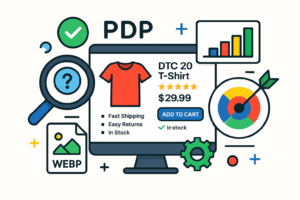
Product detail pages (PDPs) are where buying decisions are made. No matter how strong your visibility is at the blog or category level, if your PDPs are weak, you’ll leak revenue. In 2025, high-performing D2C brands treat PDPs as a blend of merchandising, persuasion, search optimization, and conversion science. They are not static product listings—they are decision engines that help users feel confident enough to buy now and buy again.
From an SEO and AEO perspective, PDPs must clearly describe what the product is, who it’s for, what problems it solves, and what makes it different. Avoid copying manufacturer descriptions or writing thin, generic copy. Instead, create unique descriptions that highlight benefits, use cases, ingredients or materials, and clear outcomes. Incorporate detailed attributes such as sizes, variants, usage instructions, care details, and geo-relevant information when needed. This level of clarity not only helps search engines understand the product but also feeds AI-driven answer systems with richer data.
Equally important is how PDPs handle social proof and trust. Ratings, reviews, user-generated content, and before/after visuals all reduce perceived risk. Make it easy for users to see real results, FAQs, and returns or warranty details. When you combine this with clean pricing, shipping, and delivery information, the page becomes a reliable decision environment. This trust layer significantly improves conversion rates for both organic visitors and users arriving from Google Ads or Meta retargeting campaigns.
Performance and UX can’t be ignored. PDPs are often heavy due to multiple images, variant selectors, recommendation widgets, and tracking scripts. Slow loading times and layout shifts frustrate buyers and impact Core Web Vitals. Optimize image formats and sizes, lazy-load below-the-fold content, reduce script bloat, and prioritize above-the-fold clarity. Ensure the primary CTA remains visible, obvious, and usable on all devices. A strong PDP should feel fast, intuitive, and persuasive on both desktop and mobile.
Finally, connect PDPs into your broader SEO system. Use breadcrumb navigation to reinforce structure, link back to categories and related products, and add FAQ content that answers specific pre-purchase objections. Implement Product, Offer, Review, and AggregateRating schema to unlock richer search experiences and improve visibility in AI Overviews. For a complete, step-by-step playbook, follow the PDP Optimization Guide 2025, which is designed to help D2C teams turn product pages into revenue engines.
6. Content Strategy for Organic Demand Creation
E-commerce SEO without a robust content strategy quickly hits a ceiling. Categories and PDPs capture existing demand, but they don’t always educate, shape, or expand it. To build a compounding growth engine, D2C brands need a content layer that attracts, educates, and nurtures potential buyers long before they’re ready to purchase. This is also where you can show up in AI-driven experiences, “People also ask” features, and long-tail search journeys.
Start by mapping content topics to real customer questions and use cases. For example, a skincare brand might create content around “how to build a nighttime routine,” “vitamin C vs niacinamide,” or “how to layer serums without irritation.” A nutrition brand might cover “high protein snacks for busy professionals,” “how to understand nutrition labels,” or “low sugar snack options for kids.” The goal is not to push products in every paragraph, but to offer genuinely helpful, practical advice that earns trust.
From a structural perspective, think in terms of clusters. Each core category on your site should have a set of supporting articles that explore related subtopics, comparisons, and “how-to” guides. For instance, if you have a category for “Vitamin C serums,” you might support it with content like “How Vitamin C Works on Skin,” “Vitamin C vs Retinol: Which Is Right for You?”, and “Best Vitamin C Serums Under ₹1000.” These articles should link back to the category and selectively to PDPs, reinforcing relevance and guiding users deeper into your store.
As you write, keep Google’s helpful content guidelines front and center. Avoid generic, AI-sounding answers. Instead, bring in your brand’s expertise, test results, customer insights, and clear examples. Content should be written for people first, while still being structured for search using headings, lists, FAQs, and clear language. This kind of high-quality, experience-backed content not only performs in traditional search but also stands a better chance of being summarized accurately in AI Overviews and other answer experiences.
To maintain consistency across this content layer, your messaging framework matters a lot. The Messaging Blueprint 2025 can help you define the core themes, value propositions, and proof points that should show up across blogs, categories, PDPs, and ads. When content, SEO, and messaging align, you build a brand that feels coherent and trustworthy across search, paid, and on-site experiences.
7. ICP Development for Search-Led Growth
Strong E-commerce SEO starts long before you open your keyword research tool. It starts with a precise understanding of your ideal customer profile (ICP). Without clarity on who you are serving, what problems they care about, and how they search, SEO becomes guesswork. You end up chasing volume instead of relevance, ranking for keywords that attract the wrong visitors, or creating content that never truly moves revenue.
Developing a clear ICP means going beyond demographics. You need to understand customer pain points, motivations, buying triggers, objections, and the language they naturally use. For instance, a fitness snack brand may serve busy professionals who want high protein with low sugar and clean ingredients. Their search behavior, content consumption, and purchase triggers will be very different from that of college students looking for budget-friendly snacks or high-performance athletes training competitively.
Once your ICP is defined, you can map their search journey across intent layers. What do they search for when they first notice a problem? How do they compare brands and products? What specific concerns or objections do they research before purchasing? These questions shape your keyword research and help you prioritize content and category structures that align with real behavior. Instead of creating a random mix of blogs and landing pages, you build an intentional search funnel for each ICP segment.
ICP clarity also guides geo-intent and AEO strategy. If your brand serves specific regions or markets, you can tailor content and product positioning to those geographies, ensuring your store is better aligned with local search behavior. It also helps you decide which product attributes to emphasize in your structured data and PDP copy. The more your site reflects how your ICP speaks and decides, the more relevant you appear to both users and search systems.
The ICP Development Framework 2025 provides a structured way to capture these insights and translate them into marketing and SEO decisions. By aligning your ICPs with category architecture, content clusters, and PDP messaging, you create a search strategy that attracts the right people, reduces wasted traffic, and makes every visit more likely to convert.
8. Competitive Analysis for E-commerce SEO Dominance
No E-commerce SEO strategy exists in a vacuum. Your performance is always relative to competitors fighting for the same search real estate and customer attention. A structured competitive analysis reveals where you can realistically win, where you need to differentiate, and how to prioritize your roadmap. It turns vague ideas like “we need more content” into focused actions like “we need three stronger category pages in this specific sub-niche to outrank competitor X.”
Start by identifying your real search competitors. These are not always the same as your perceived brand competitors. In many categories, marketplaces, review sites, blogs, and niche aggregators dominate the search results. Analyze which domains consistently appear in the top positions for your priority head and long-tail keywords. Note how they structure their category pages, PDPs, and content. Pay close attention to their on-page copy, product attributes, FAQs, and how they address objections.
Beyond page structure, evaluate their technical and UX foundations. How fast do their pages load? Do they implement product, offer, review, and breadcrumb schema well? Is their site architecture clean and logical? Do their PDPs communicate benefits clearly and showcase trust signals such as reviews, certifications, and guarantees? Benchmarking these elements gives you a practical reference point for the minimum standard you must meet—and where you can go further to stand out.
Content and messaging are equally important. Look at the topics and formats they use: buying guides, how-tos, comparisons, case studies, and educational hubs. Analyze how deeply they cover each topic, what angles they choose, and how they position their brand versus alternatives. Spot gaps where important customer questions aren’t being answered well or where content is shallow or outdated. These gaps become opportunities for your own content and cluster strategy.
The Competitive Analysis Framework 2025 is designed to make this analysis repeatable and actionable. It helps you align SEO opportunities with positioning decisions, ensuring you’re not just copying competitors but deliberately carving out a stronger, clearer place in the market. Done regularly, competitive analysis becomes a strategic lens that keeps your E-commerce SEO roadmap grounded in reality and focused on high-impact moves.
9. AEO (AI Search Optimization) for D2C Brands
AI-driven search experiences—like Google AI Overviews and other generative answer systems—are changing how users see and interact with information. For D2C brands, this doesn’t replace E-commerce SEO, but it does change what “visibility” looks like. Your content and product data must now be structured and clear enough that AI systems can confidently summarize and surface them while still giving users reasons to click through to your site.
At a practical level, AEO starts with strong semantic structure. Your pages should organize information with descriptive headings, concise paragraphs, lists, FAQs, and clear answers to specific questions. For example, if customers often ask “Is this safe for sensitive skin?” or “Can I use this snack on a low-carb diet?”, those questions should be directly answered on your PDPs, category pages, and relevant blog posts. This question-and-answer format aligns naturally with how AI systems extract and present snippets.
Structured data also plays a major role in AEO. By implementing comprehensive product, offer, review, and FAQ schema, you give search systems a rich, machine-readable understanding of your catalog and content. This improves your eligibility for rich results today and supports AI Overviews and other experiences tomorrow. Pair this with internal linking that clearly connects related content, categories, and PDPs, and you strengthen the contextual graph around your brand.
Another aspect of AEO is demonstrating authority and trust. Google’s helpful content guidelines and E-E-A-T (Experience, Expertise, Authoritativeness, Trustworthiness) principles still apply. Your content should reflect real expertise, reference real experiences, and avoid empty claims. Detailed explanations, evidence-based recommendations, and honest pros and cons help AI systems recognize your content as a reliable source. Over time, this increases the likelihood that your brand is cited or surfaced in AI-driven experiences.
To support these efforts, use resources like the Schema Guide and the Internal Linking Framework. Together, they help you design pages that are easy for both humans and AI-driven systems to understand. AEO is ultimately an extension of good SEO and UX practices: structure information clearly, answer real questions, and ensure your product data is complete and accurate.
10. UX & CRO: Converting Traffic into Revenue
SEO, AEO, and GEO bring the right visitors to your store, but user experience (UX) and conversion rate optimization (CRO) determine what happens next. If pages are slow, confusing, or untrustworthy, rankings and traffic will not translate into revenue. D2C brands that win in 2025 treat UX and CRO as integral parts of their E-commerce SEO strategy, not as separate or optional tasks.
Good UX begins with clarity. When someone lands on a PDP or category page, they should instantly understand what the page is about, who the products are for, and what they should do next. That means clear headlines, straightforward benefit-driven copy, and a prominent call-to-action. Avoid cluttered layouts, ambiguous messaging, and competing CTAs. On mobile especially, make sure key information and the primary action are visible without excessive scrolling or tapping.
Trust signals are another essential part of conversion-focused UX. Reviews, ratings, user-generated photos, certifications, return policies, and secure checkout badges all reduce perceived risk. Present them in a way that feels natural and supportive rather than overwhelming. For example, show an overall rating near the top of the PDP and detailed reviews lower on the page. Use snippets of testimonials on category pages and in relevant content to reinforce credibility at different stages of the journey.
From a CRO perspective, you should continuously test hypotheses based on user behavior and analytics, not just gut feeling. Use tools like heatmaps, session recordings, and funnel reports to identify friction points: where users drop off, hesitate, or get confused. Then design A/B tests to improve those specific areas—simplifying a form, clarifying copy, repositioning a CTA, or changing how you show pricing or bundles. As you optimize, keep SEO fundamentals in mind so changes don’t inadvertently harm rankings or structured data.
Finally, CRO should be coordinated with performance marketing. When your landing pages (categories, PDPs, and content) are optimized for conversion, every click from Google Ads, Meta Ads, email, and influencers becomes more valuable. This alignment is where you start to see improved ROAS and stronger overall profitability. For deeper guidance on building this connection between UX, CRO, and acquisition, explore the foundation here: Website Design & Development.
11. How E-commerce SEO Improves Google Ads & Meta Performance
E-commerce SEO and paid media are often treated as separate worlds, managed by different teams with different goals. In reality, they are deeply connected. When your site is structured well for SEO—with clear categories, strong PDPs, and relevant content—your Google Ads and Meta campaigns naturally perform better. Aligning these efforts turns your website into a shared growth asset instead of a set of disconnected landing pages.
On the Google Ads side, landing page quality and relevance are core components of Quality Score. When your PDPs and category pages are optimized for the same intent as your ad groups and keywords, they deliver higher relevance and better user experience, which can reduce CPCs and improve average positions. For example, if you target “low sugar protein bars for office snacks,” sending users to a well-optimized category page that explicitly presents that use case is far more effective than sending them to a generic homepage or misaligned PDP.
Meta Ads benefit similarly. While Meta’s targeting is based on behavior and interests rather than keywords, the destination experience still matters. When users land on fast, clear, benefit-driven PDPs or pre-sale education pages that match the promise of the ad creative, click-through and conversion rates improve. Better on-site experience increases the efficiency of your retargeting funnels as well. Visitors who don’t convert on the first visit leave with a stronger understanding of your brand and products, making retargeting campaigns more effective.
SEO-driven content also provides valuable top-of-funnel assets for paid campaigns. Educational articles, buying guides, and comparison pieces can be used as landing pages for cold audiences, especially in upper-funnel Meta campaigns. This allows you to introduce the brand, demonstrate expertise, and build trust before pushing for a direct sale. When these pages are built with SEO best practices, they pull double duty by capturing organic traffic at the same time.
To operationalize this alignment, use shared naming conventions and structures between your SEO architecture and paid campaigns. Map campaigns and ad groups to specific categories, PDPs, and content clusters. This makes performance analysis cleaner and helps you spot where improvements in SEO and UX could deliver a direct uplift in ROAS. To explore performance marketing strategy through this lens, use the Performance Marketing guide as a complement to this SEO pillar.
12. When Should a D2C Brand Invest in E-commerce SEO?
Every D2C brand knows SEO is important, but many struggle with timing and prioritization. The truth is, the best time to invest in E-commerce SEO is usually earlier than most brands expect. Waiting until paid channels become too expensive or growth stalls often means you’re starting from behind. However, there are clear signals that indicate when SEO should move from a “nice to have” to a “core growth initiative.”
If your category pages are not ranking for obvious, relevant terms, that’s a strong indicator. For example, if you sell vegan skincare and your primary categories don’t appear for “vegan face cleanser,” “vegan sunscreen,” or similar queries, you are likely leaving significant revenue on the table. The same is true if PDP traffic is flat or declining while competitors gain visibility with more structured, content-rich pages. These gaps won’t close on their own; they require focused SEO and UX effort.
Technical symptoms matter as well. Persistent indexation issues, slow mobile performance, confusing URL structures, or duplicate PDPs are all signs that search engines may be struggling to understand and prioritize your site. When these issues stack up, small fixes are not enough—you need a structured SEO and technical roadmap. Ignoring them while scaling paid campaigns often leads to diminishing returns and higher blended CAC.
Another signal is your reliance on paid acquisition. If most of your revenue comes from Google Ads, Meta Ads, or marketplaces, you are effectively renting growth. While these channels are valuable, they are also volatile. Algorithm changes, rising competition, and shifting auction dynamics can quickly change your economics. Investing in E-commerce SEO helps de-risk your growth by building an owned acquisition engine that keeps working even when paid performance fluctuates.
Finally, consider your long-term brand goals. If you aim to build a defensible, trusted, and category-leading D2C brand, strong organic and AI-driven visibility is non-negotiable. SEO, AEO, and GEO create a foundation where your brand shows up consistently whenever buyers research a problem, compare options, or validate a decision. That consistency is hard to replicate purely through paid media, and it compounds over time in a way that strengthens your entire business.
13. Final Perspective: E-commerce SEO Is a Revenue System, Not a Channel
It’s easy to think of E-commerce SEO as a checklist: fix metadata, add schema, publish a few blogs, and call it done. But the reality is very different. The D2C brands that win in 2025 treat SEO as a revenue system—a structured way to connect customer problems, search behavior, product experiences, and data into one continuous loop. When that system is in place, SEO becomes less about rankings and more about predictable growth.
At the core of this system is a strong technical foundation. Clean architecture, fast pages, robust structured data, and efficient crawlability ensure that search engines can see and understand your catalog. On top of that sits your category and PDP strategy, where you map real search and purchase intent to how you present and differentiate your products. When categories and PDPs are built as decision tools rather than simple listings, they convert better and support both organic and paid performance.
The next layer is your content and messaging ecosystem. Helpful, experience-backed content attracts and educates users earlier in their journey, building trust long before they reach your PDPs. Consistent messaging across blogs, categories, PDPs, and ads creates familiarity and reinforces the reasons to choose your brand over alternatives. This is the layer where you show depth, expertise, and empathy—qualities that AI-driven systems and human buyers both reward.
Finally, analytics, UX, and experimentation hold everything together. Continuous measurement of search performance, on-site behavior, and conversion outcomes allows you to refine each part of the system. Instead of running isolated projects, you iterate on a cohesive engine: improving technical health, rewriting PDPs, expanding content clusters, and adjusting UX based on what actually moves revenue. Over time, SEO shifts from a project you “do” to a capability your brand “has.”
Seen this way, E-commerce SEO is not in competition with performance marketing or brand building. It amplifies both. It gives your ads better destinations, your brand more credible visibility, and your leadership team a more predictable, profitable engine for growth. That is the mindset this guide is designed to support—and the reason it connects directly to the supporting frameworks across PDPs, categories, messaging, ICPs, and competitive analysis.
14. Your Next Strategic Actions
Turning this guide into results requires focused execution, not just insight. The first step is to assess where you are today across the core pillars: technical health, category strength, PDP quality, content ecosystem, ICP clarity, and competitive position. Even a simple, structured audit will reveal which levers can drive the fastest impact for your D2C brand in the next 60–90 days, and which areas will require deeper investment over the coming quarters.
From there, you can begin prioritizing actions. For many brands, a high-impact starting point is to optimize a handful of core categories and PDPs that already drive meaningful revenue or have clear search potential. Implement better on-page structure, stronger messaging, product and review schema, and UX improvements on those pages first. Monitor the impact on rankings, traffic, and conversion rates, and use those learnings to roll out improvements across the rest of the catalog.
In parallel, start building or refining your content and messaging system. Use your ICP insights to map content clusters around your highest-impact categories. Create guides, comparisons, and educational pieces that answer real questions and link them back to relevant collections and products. This strengthens topical authority, supports AEO and GEO, and ensures that organic visitors at every stage of the journey can find something helpful and relevant.
If you’re ready to go deeper, explore the connected frameworks that sit around this pillar page and turn it into a living system:
- Explore E-commerce SEO Services – to design and implement an end-to-end strategy.
- Optimize PDPs for Conversion – to turn product pages into revenue engines.
- Fix Category Page SEO – to strengthen your primary revenue drivers.
- Strengthen Brand Messaging – to align copy and positioning across every touchpoint.
- Define High-Intent ICPs – to ensure your SEO strategy focuses on the right buyers.
- Improve Paid Performance – to connect SEO, UX, and performance marketing into one growth engine.
Done well, E-commerce SEO becomes the compounding engine behind your D2C brand: every new product, campaign, and market you enter benefits from an existing foundation of visibility, trust, and conversion-ready experiences. That is how you move from chasing growth to building it deliberately, month after month.