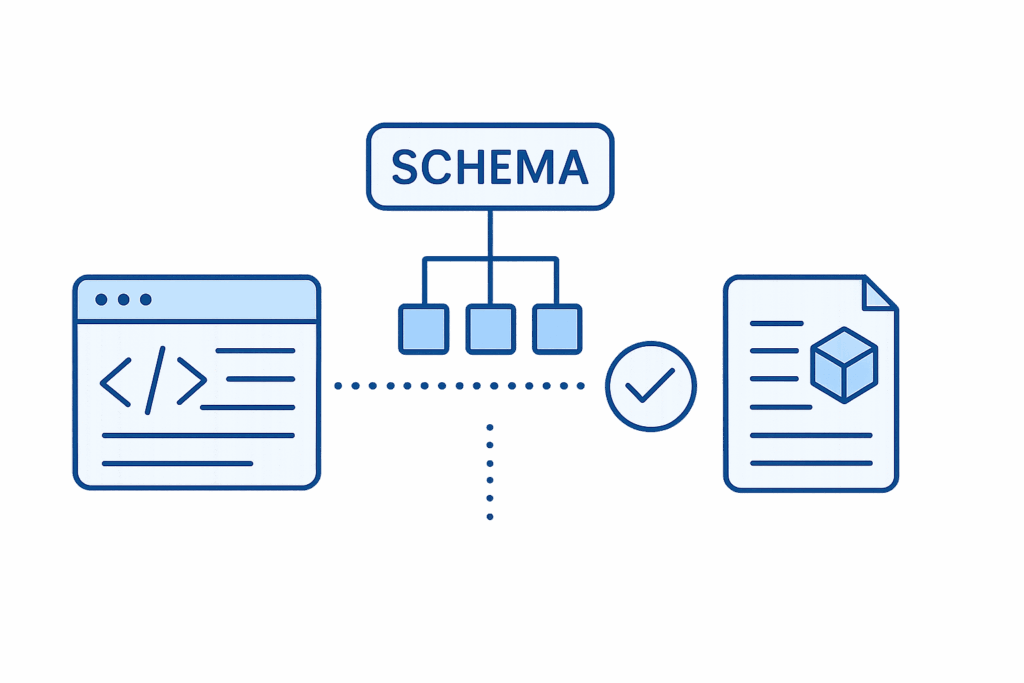
Structured data has become one of the strongest ways to help search engines understand your content, improve search visibility, and support AI-driven results such as Google’s AI Overviews. In 2025, semantic clarity is more important than ever. Search engines prioritize context, relationships, and the intent behind your content — schema markup helps communicate all of this in a structured, machine-readable format.
This guide explains what structured data is, why it’s crucial in 2025, how it impacts SEO, and the exact schema types every website should implement. If you’re strengthening your overall technical foundation, consider pairing this guide with the Technical SEO & Analytics Guide.
1. What Is Structured Data?
Structured data is a standardized format (JSON-LD) that explains the meaning of your content to search engines. It helps Google understand whether your page is about a service, article, product, organization, FAQ, software, or any other entity. This clarity increases the likelihood of appearing accurately in search and AI-powered summaries.
Structured data improves:
- Search engine understanding
- AI Overviews & generative summaries
- Rich result eligibility
- Topical and semantic clarity
- Overall content classification
2. Why Schema Markup Matters in 2025
Google now relies heavily on entities rather than traditional keyword signals. Schema helps establish those entities by defining what your content represents and how pages relate to each other. Without schema, Google may still interpret your content — but with schema, your meaning becomes explicit rather than implied.
This clarity improves search visibility, supports AI systems, and helps Google categorize your content correctly. This matters even more in competitive categories like e-commerce, B2B SaaS, digital commerce, and real estate.
3. How Structured Data Supports SEO
Structured data is not a direct ranking factor, but it improves ranking conditions dramatically by helping search engines interpret your pages more accurately. Schema supports:
- Better classification of content
- Cleaner matching between queries and pages
- More visibility in rich results
- Improved CTR through enhanced snippets
- Greater relevance for AI-driven experiences
Search engines also rely heavily on internal context. Google’s documentation on crawlable links explains that internal links must be easily discoverable to support indexing. Research from Semrush, Backlinko, and Moz also highlights how internal linking strengthens crawl flow and distributes relevance. When structured data and internal linking work together, your pages become easier for search engines to understand, improving both visibility and topic alignment.
4. Important Schema Types Every Website Should Use
4.1 Organization
Defines who you are — your brand information, logo, URL, and attributes. Should be implemented sitewide.
4.2 Website
Provides context about your website, homepage, and internal search functionality (if applicable).
4.3 ProfessionalService
Ideal for service pages. Examples include:
4.4 BreadcrumbList
Helps Google understand your page hierarchy and improves navigation clarity.
4.5 Article / BlogPosting
For blogs, guides, insights and educational resources.
4.6 FAQPage
Use only when your page contains real, visible Q&A sections.
4.7 Product (if relevant)
Essential for e-commerce or SaaS product pages.
5. Example: ProfessionalService Schema
{
  "@context": "https://schema.org",
  "@type": "ProfessionalService",
  "name": "Technical SEO Consulting",
  "url": "https://www.technorhythms.com/technical-seo-consulting/",
  "description": "Technical SEO consulting to improve indexing, site speed, Core Web Vitals, architecture and analytics accuracy.",
  "provider": {
    "@type": "Organization",
    "name": "Technorhythms",
    "url": "https://www.technorhythms.com/"
  },
  "serviceType": "Technical SEO",
  "areaServed": "Global"
}
6. Example: BlogPosting Schema
{
  "@context": "https://schema.org",
  "@type": "BlogPosting",
  "headline": "Structured Data & Schema Markup Guide (2025 Edition)",
  "description": "A complete guide to implementing structured data and schema markup in 2025.",
  "author": {
    "@type": "Organization",
    "name": "TRM Editor Team"
  },
  "publisher": {
    "@type": "Organization",
    "name": "Technorhythms"
  },
  "mainEntityOfPage": "https://www.technorhythms.com/structured-data-schema-markup-guide/"
}
7. Structured Data & AI Search (AEO)
Schema markup is one of the most influential signals for AI-driven search systems. It improves:
- Entity detection
- Answer extraction
- Semantic understanding
- Accurate placement in AI summaries
When structured data aligns with strong content fundamentals, it increases your chances of appearing in richer, more valuable AI results. Supporting resources such as Internal Linking Strategy and Website Audit Guide complement this effort by strengthening content clarity.
8. Common Schema Mistakes to Avoid
- Schema that does not match visible content
- Copy-pasting identical schema across all pages
- Missing required fields
- Using deprecated schema types
- Embedding schema in
<body>instead of<head> - Nesting errors that prevent parsing
Always validate schema using Google’s Rich Results Test.
9. Industry-Specific Schema Opportunities
Real Estate
Use Place, Apartment, Offer, and LocalBusiness when relevant. Learn more: Real Estate.
E-commerce / D2C
Product, Review, Offer and breadcrumbs help improve visibility and conversion clarity. More here: E-commerce SEO.
B2B SaaS & IT
Use SoftwareApplication, HowTo and FAQPage for interactive, documentation-rich sites. See the SaaS & IT page.
10. Quick Structured Data Checklist
- Correct schema type on every page
- Schema matches visible content
- Absolute URLs used
- Breadcrumbs implemented
- Unique service schema for each offering
- BlogPosting schema used for articles
- No errors in Rich Results Test
11. When to Seek Support
If your website uses multiple templates, custom sections, or dynamic content, implementing schema properly may require specialized help. Incorrect or incomplete schema can hurt your visibility.
12. Final Thoughts
Structured data is one of the most valuable enhancements you can apply to your website. It increases search clarity, supports AI Overviews, improves classification and enhances how search engines interpret your brand. When aligned with strong internal linking, optimized performance and clean architecture, schema markup becomes a powerful driver of visibility and long-term growth.
Start with the essential schema types, validate your markup regularly and expand your structured data layer as your website grows.