Most of what you read about business listings in ChatGPT this week will tell you to go and claim yours. That advice is correct, and it takes about ten minutes. It also skips the part that will actually change how you work. For the first time, OpenAI is showing businesses what people were talking about when ChatGPT cited their website. Answer engine optimisation has been real work with no scoreboard. As of this week, there is one.
What OpenAI actually shipped
OpenAI announced Businesses in ChatGPT on 10 November 2026. It is in beta, and it has three parts.
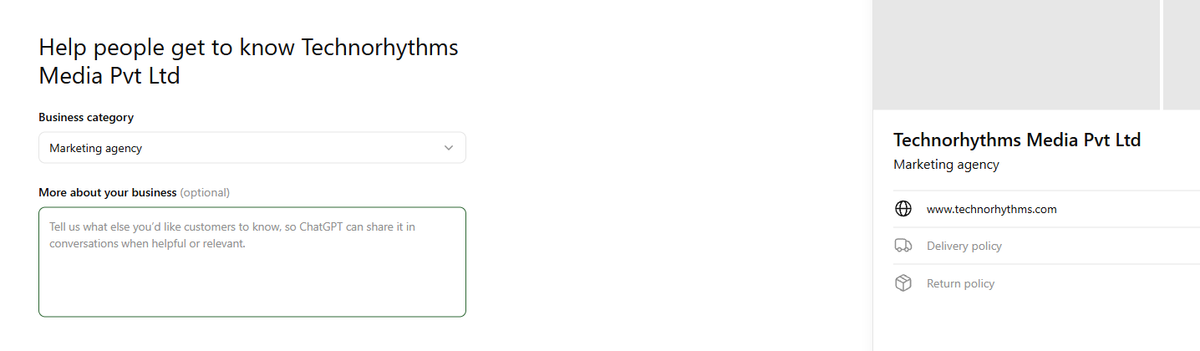
Business Hub lets you claim your organisation, verify it, and keep your details current. Verified businesses can add self-service product feeds carrying pricing and availability. Shopify merchants can connect a store from the Hub or from the Shopify admin to streamline verification, and eligible Shopify products are already flowing into ChatGPT through Shopify Catalog.
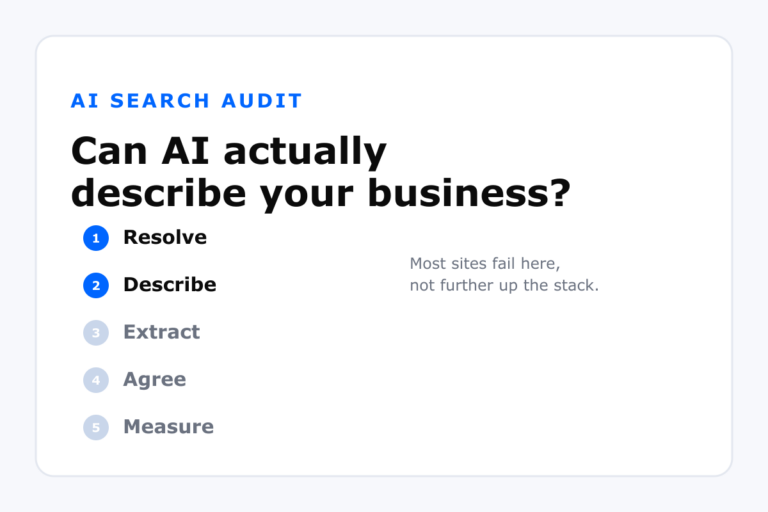
Insights report how many times your business was mentioned, how many website clicks you received, and your discovery topics, which OpenAI describes as the common themes across conversations where your website is cited. Before you read too much into the topics, check that a model can describe you at all, which the AI search audit walks through.
Business Agents are conversational agents a person can open from your ChatGPT profile to ask follow-up questions about your offering. The conversation is labelled, kept separate from the user’s original ChatGPT thread, and distinct from ChatGPT’s own independent answers. Businesses can sponsor an agent and use it as the destination for ChatGPT Ads.
The limits matter as much as the features. Business Agents are live only for eligible ecommerce and online service businesses in the United States. Claiming and insights are open to eligible businesses anywhere ChatGPT is available. If you sell B2B software from Pune, or property from a Dubai sales office, the Hub and the insights are what you get today. That is still the part worth your attention.
What you actually get from claiming
It is free, so the cost question is really a time question. Here is what the ten minutes buys, in rough order of value.
Control over the facts
Before this, what ChatGPT said about your business was assembled from whatever it found. If your pricing page was stale or your name was ambiguous, that is what got repeated. A verified listing gives you a direct line into the answer. For anyone who has spent a year on AEO and GEO without a way to correct a wrong answer, this is the first lever that touches the output directly.
Measurement where there was none
Mentions, website clicks and discovery topics. Three numbers that did not exist last week. Whatever you think of their precision in beta, they turn an unfundable line item into one you can argue for, because it finally reports something. That matters more than it sounds: budget follows measurement, and AI search has had none.
A first-mover window on the data
It is not clear whether insights backfill to before your claim date. If they do not, every week you wait is a week of data you never get. That asymmetry is the strongest argument for claiming today rather than adding it to next quarter’s plan, and it costs you nothing if the data turns out to backfill anyway.
Live pricing and availability, if you sell online
Product feeds carry price and stock into the answer itself. For a D2C brand, that is the difference between being described and being shoppable. Treat the feed with the same discipline as your ecommerce SEO work, because a wrong price surfaced inside an AI answer is worse than no price at all.
A qualification layer, where agents are available
A Business Agent answers follow-up questions without a human. For eligible US ecommerce and online service businesses, that is a pre-sales conversation happening at a moment of genuine intent, which is a better position than a contact form reached three clicks later.
Why the insights matter more than the listing
A listing corrects what ChatGPT says about you. That is hygiene, and hygiene is worth ten minutes.
Discovery topics are something else. They tell you which conversations you are already being pulled into. That is the closest thing to a Search Console query report that AI search has produced, and it answers a question you have probably been guessing at. Not whether AI search sends traffic, but what people were actually trying to decide when your name came up.
Those are different inputs. One tells you your name is spelled right. The other tells you which problems you are already trusted to answer, and by omission, which ones you are invisible for. The second belongs in your content roadmap, not your housekeeping list.
The practical move is to read your discovery topics against the pages you have actually published. Where a topic appears and you have a strong page, you have confirmation. Where a topic appears and you have nothing, you have a brief. Where you have published heavily and the topic never appears, you have an uncomfortable but useful signal about what the market is not asking you for.
That third case is the one worth sitting with. It usually means the topic is served by someone with more authority, or that you wrote for a keyword rather than a question. If you want the mechanics of how models choose what to cite, we covered them in SEO vs AEO vs GEO and in more depth in what answer engine optimisation actually is.
Mentions minus clicks is your new answer-share number
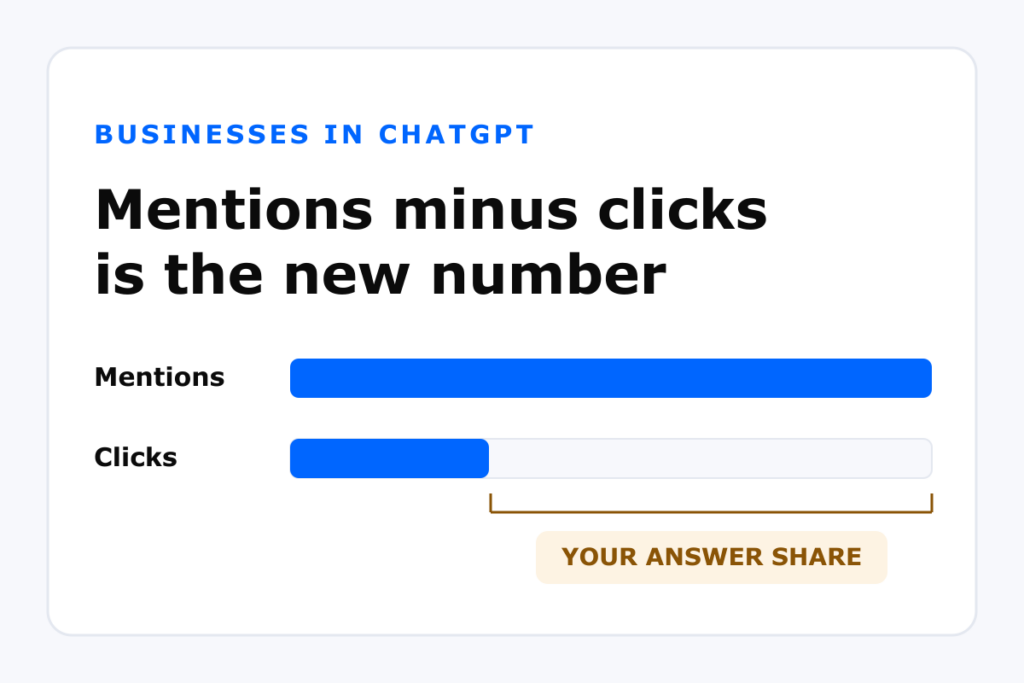
You now get two counts: mentions, and website clicks. The gap between them is the number nobody has had before.
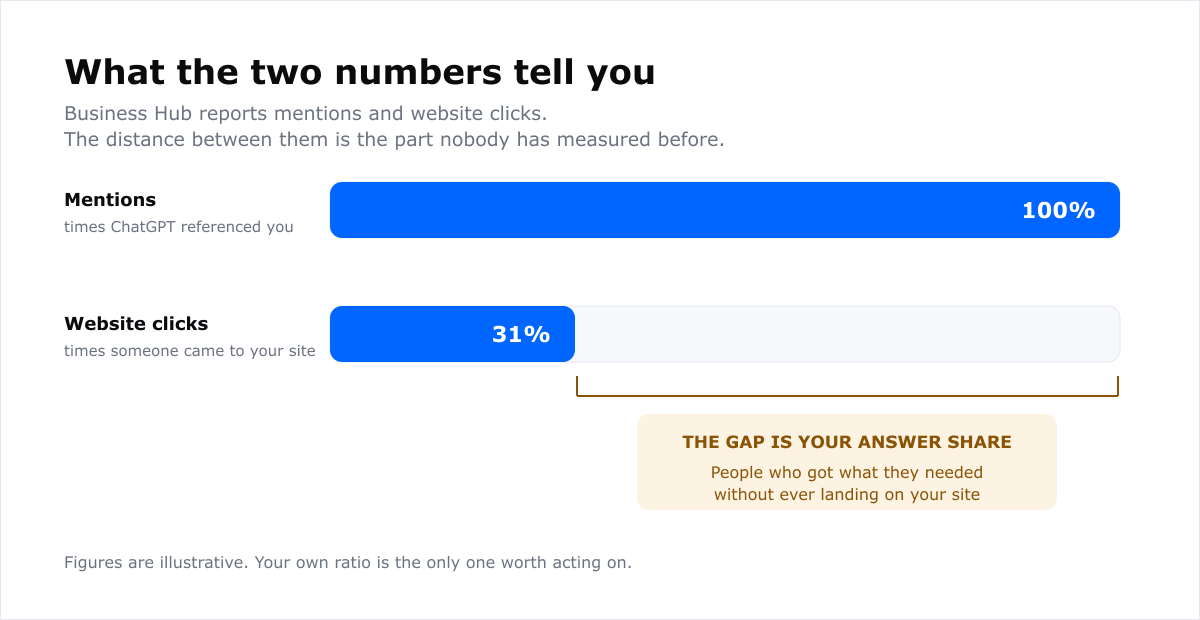
A large gap means ChatGPT is answering on your behalf. People are getting what they needed without arriving on your site. The reflex is to call that stolen traffic and start trying to close the gap.
Resist that reflex for a quarter. A mention that carries your framing to someone who was never going to click is not a loss, and a click from someone who bounces in four seconds is not a win. Which one is worth more depends on whether those mentions eventually show up as branded search, direct visits, or named enquiries. You can see that in your existing analytics, but only if your measurement layer is clean enough to tell a branded visit from a generic one.
If you want one practical instrument for this, segment branded organic and direct traffic in GA4 now and watch that line against your mentions count over the next two quarters. That comparison is worth more than any single-session attribution you will get from the Hub itself. The setup is the same discipline we walk through in the data layer playbook, and the reporting logic follows our performance marketing measurement guide.
Take your baseline before you change anything
Here is the mistake we expect to see most often over the next month. A team claims the listing, rewrites the business description, updates their schema, ships four new pages, and adds an FAQ block, all in the same week. The numbers move. Nobody can say which change moved them, so the next decision is a guess dressed up as a strategy.
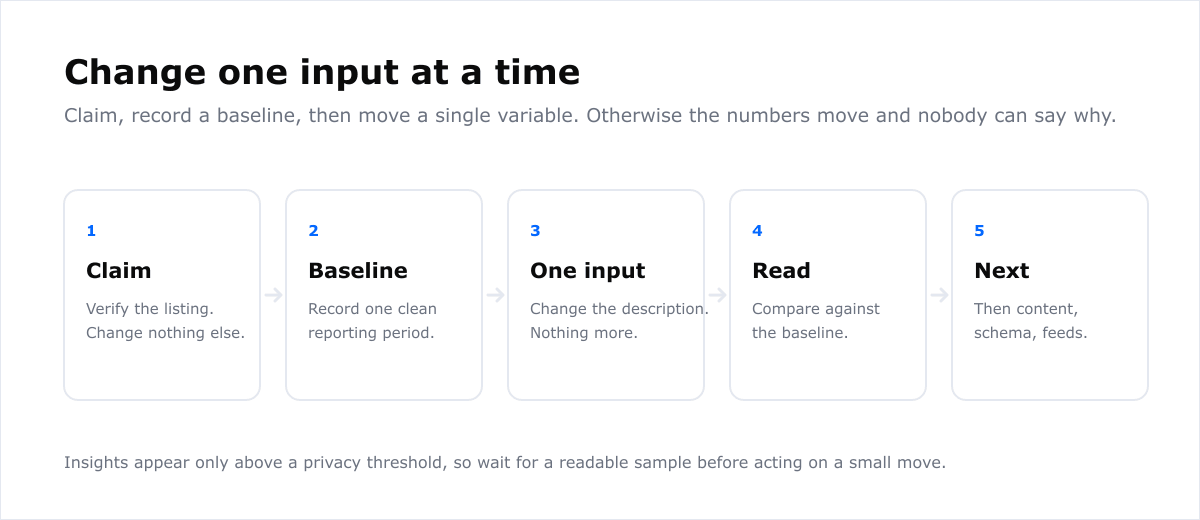
- Claim and verify, and change nothing else. Let the listing sit as it is.
- Record one full reporting period untouched. Mentions, clicks, and the discovery topics as they stand. That is your baseline.
- Change one input. The business description is the obvious first candidate, because it is the only thing you fully control.
- Wait, then read. Note the direction and the size of the move against your baseline.
- Then change the next thing. Content, schema, or product feeds, one at a time.
One caveat on reading the data at all. OpenAI aggregates insights and only shows them once there are enough conversations to meet a privacy threshold. If you are a low-volume or narrow-niche business, you may see very little at first, and small movements in small numbers are noise. Wait for a readable sample before you act on anything.
What to write in the business description
The description field is free text, and ChatGPT draws on it when your business comes up in conversation. That makes it retrieval material, not brand copy. Adjectives do not get quoted. Facts do.
What you actually are, in plain category terms
If your name is ambiguous, say what you are explicitly. We hit this ourselves. Technorhythms Media Private Limited reads like a record label or a video production house. A model resolving our name alone could reasonably file us under music, and then we never surface for a marketing query at all. One sentence fixes that, and it is the single highest-value line in the field for anyone whose name does not announce its own category.
Where you operate
Cities and countries, written out. “Remote” is useful, but it is not a place anyone searches with. If you serve clients in markets where you have no office, say that too, because the question people ask is about coverage rather than address.
Who you are for
Name the sectors and the company profile you work with. A prospect asking ChatGPT for help is usually describing their own situation in the question, so the match happens on specifics. “B2B SaaS and IT, real estate, and D2C ecommerce” gives a model something to match against. “Businesses of all sizes” gives it nothing. If you have never written this down properly, the exercise is the same one as building an ideal customer profile, and the output of a messaging blueprint drops straight into this field.
What you cost
This is the line most businesses will skip, and it is the one we would keep. If your pricing is nowhere, ChatGPT cannot answer “can I afford them” and will favour a business whose answer it does know. Bands are enough. If your website already shows ranges on an enquiry form, you are disclosing nothing new and you are filtering out the conversations you did not want in the first place.
How this differs from a Google Business Profile
The instinct is to treat this as a new directory listing and hand it to whoever owns Google Business Profile. The mental model does not transfer cleanly.
| Google Business Profile | Businesses in ChatGPT | |
|---|---|---|
| Primary job | Local discovery and directions | Accuracy inside a conversation |
| Trigger | A search with local intent | Any conversation where you are relevant |
| What you see | Searches, views, calls, direction requests | Mentions, website clicks, discovery topics |
| Geography | Tied to a physical location | Not location-bound |
| Unit of competition | Proximity and review volume | Clarity of your information |
| Who it suits | Anyone with a storefront or service area | Anyone who gets described rather than searched for |
The last two rows are the ones that matter for B2B. A Google Business Profile rewards you for being findable in a place. A ChatGPT listing rewards you for being describable in a situation. Those call for different information, which is why copying your Google Business Profile description into the Hub is a wasted opportunity.
What this changes for each sector
B2B SaaS and IT
Long cycles and buying committees mean several people research the same purchase separately, and at least one of them is now asking an AI instead of opening ten tabs. Discovery topics tell you which stage of that committee’s thinking you are showing up in. Being cited on “how do we fix attribution” is a different position from being cited on “best alternatives to X”, and they call for different pages. If your events and stages are not clean enough to connect a mention to an eventual opportunity, start with the analytics architecture for SaaS before you read too much into the numbers. More on the sector view on our B2B SaaS and IT page.
Real estate
Enquiries already scatter across portals, forms, calls and messaging apps, which is why last-click reporting has never worked well here. Another unattributed discovery channel is the last thing this sector needs, so the mentions count is worth tracking from day one, even while Business Agents remain out of reach outside the US. The fix is the same one we describe in fixing broken tracking for developers, and the sector detail sits on our real estate page.
D2C and ecommerce
This is the sector with the most to gain right now. Product feeds carrying pricing and availability are live, Business Agents are open to eligible US ecommerce, and Shopify merchants have the shortest route in. If you sell online in the United States, this release is not a listing update, it is a new storefront surface. The pages that feed it are the ones you already work on, so category architecture and product page depth still decide what an AI has to work with. See our digital commerce page for how we approach it.
What we do not know yet
Worth being straight about, because confident claims will be everywhere this week and most of them are unverifiable.
- Whether claiming makes you more likely to be cited. OpenAI does not say that it does. The stated purpose is accuracy of information, not ranking.
- Whether insights backfill. It is not clear whether you see data from before your claim date. That alone is an argument for claiming early.
- How eligibility is decided beyond the categories OpenAI has published.
- What the privacy thresholds actually are. OpenAI says insights appear only above a threshold, without publishing the number.
- How discovery topics are grouped, which decides how specific a brief you can write from them.
- When Business Agents reach other markets. OpenAI says it plans to expand to more markets and categories, without a timeline.
Treat this release as instrumentation rather than a ranking lever, and it will not disappoint you.
What to do this week
- Claim and verify your business in Business Hub.
- Upload the same logo your Organization schema points to, so your listing and your markup agree. If that markup is thin, our schema markup guide covers what belongs in it.
- Write the description as facts: category, locations, sectors served, price range, contact.
- Record your baseline, and resist changing anything else until you have read one clean period.
- Segment branded organic and direct traffic in GA4 so you can watch the lagged effect of mentions.
- Add the profile URL to the
sameAsarray in your Organization schema once you have one. - Check that the pages behind your strongest discovery topics are actually linked from somewhere sensible. Our internal linking framework covers the structure.
The listing is ten minutes of work. The habit of changing one input at a time is what will still be paying you in six months.
- Claim now, because it is unclear whether insights cover the period before you claim
- Discovery topics, not the listing itself, are the strategic unlock
- The gap between mentions and website clicks is your answer-share signal
- Baseline first, then change one input at a time, or you will never know what worked
- Write the description as retrieval facts: category, location, sectors, price, contact
- A Google Business Profile rewards being findable in a place; this rewards being describable in a situation
- Business Agents and product feeds are US ecommerce and online services only for now
Most teams cannot separate branded from generic traffic cleanly enough to read a lagged AI-search effect. That is a tracking problem, and it is fixable before the data starts arriving.
See how we rebuild measurement