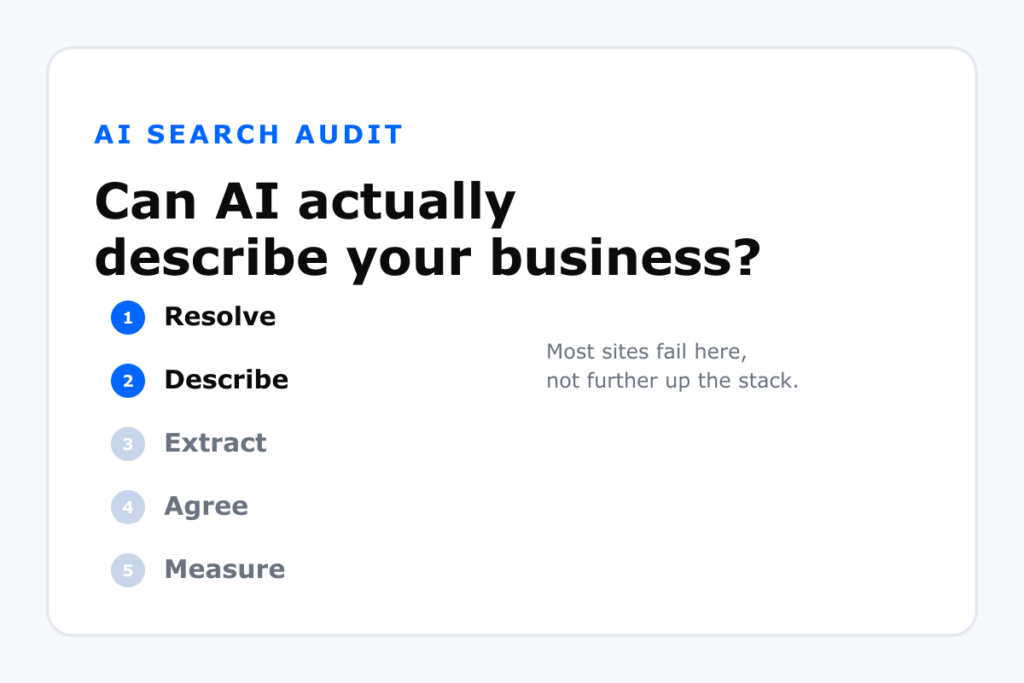
Open ChatGPT, Claude and Gemini in three tabs and ask each one the same question: “What does [your company] do?” Do not prompt them further. Read the three answers side by side. If they disagree with each other, or with you, you have found your highest-priority marketing problem of the quarter, and it will not be fixed by publishing more content.
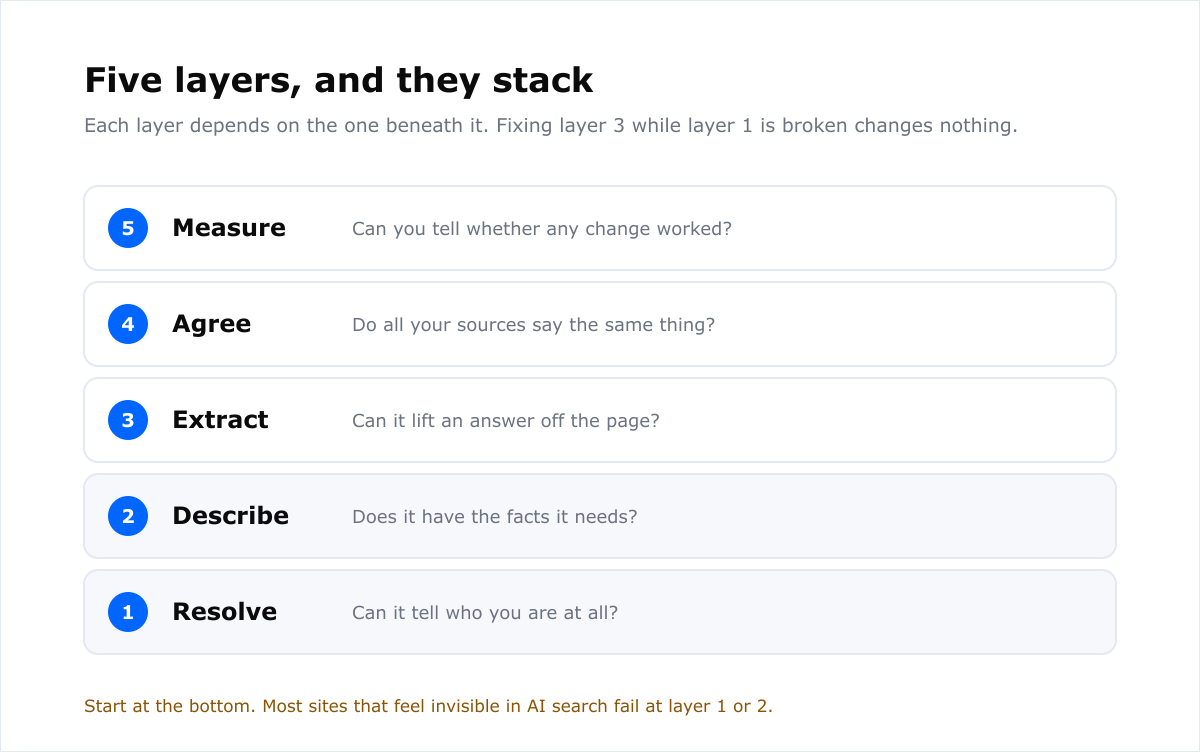
We run this audit before any AI-first SEO engagement, and the order matters more than the checklist. Each layer depends on the one below it. Rewriting page structure while a model cannot reliably tell which company you are is effort spent on the wrong floor of the building.
The 90-second test that tells you whether you have a problem
Before any of the detailed checks, run the three-assistant test described above. Ask each assistant the same four questions and write the answers in a table.
- What does [company] do?
- Who is [company] for?
- Where is [company] based?
- What does [company] cost to work with?
You are not grading the prose. You are looking for three specific failures: an answer that describes a different company, an answer that is vague where your site is specific, and two assistants that contradict each other. Any of those is a finding, and the rest of this audit tells you which layer caused it.
Run it from a logged-out or temporary session. A model that has your chat history is not seeing you the way a prospect does.
Layer 1: can a model resolve who you are?
Entity resolution happens before anything else. If a model cannot confidently decide which organisation your name refers to, nothing downstream matters, because you are never the entity being described.
Check your name against its own category
Say your company name out loud with no context and ask what business it sounds like. We failed our own check here. “Technorhythms Media Private Limited” reads like a record label or a video production house, and a model resolving that name alone could reasonably file us under music rather than marketing. The fix is a single explicit sentence wherever you describe yourself, not a rebrand.
Pass: your category is stated in plain words within the first sentence of your homepage, your meta description, your schema, and any business listing you hold.
Check your Organization schema exists and is correct
View source on your homepage and search for "@type":"Organization". It should carry your legal name, URL, logo, contact point, and a sameAs array pointing at your real profiles. If you have never looked at this, our schema markup guide covers what belongs in it.
Pass: one Organization node, not two. Duplicate nodes with different descriptions are a contradiction you are publishing about yourself.
Check your sameAs array actually resolves
Click every URL in sameAs. Dead profiles and old handles weaken the identity graph rather than strengthening it. If you hold a ChatGPT business listing, its profile URL belongs in this array too.
Layer 2: does it have the facts it needs?
A model answering “is this company right for me” needs four facts. Most sites supply one and a half.
| Fact | What good looks like | Common failure |
|---|---|---|
| Category | Plain words a buyer would use | Invented category language only you use |
| Geography | Cities and countries written out | “Global” or “remote” with no place named |
| Who it is for | Named sectors and company profile | “Businesses of all sizes” |
| Price | Bands, or a starting point | Absent entirely |
Price is the one almost everybody skips, and it is the one that decides whether you get recommended. A model asked “can I afford them” will favour a business whose answer it knows over one it has to guess at. Bands are enough, and if your enquiry form already shows ranges you are publishing nothing new.
If you cannot write the “who it is for” line crisply, that is not a website problem. It is an ideal customer profile problem surfacing in a new place, and the output of a messaging blueprint drops straight into these fields.
Layer 3: can it extract an answer off the page?
This is the layer most AEO advice starts at, which is why so much of it underperforms. It only pays once the two layers below it hold.
The test is mechanical. Take a page, pick the question it is supposed to answer, and look for a contiguous passage that answers it without needing the rest of the page. If the answer is distributed across four paragraphs and a graphic, a model has to reconstruct it, and reconstruction is where it either hedges or picks a competitor who made it easy.
- One question per heading. Phrase H2s as the question a reader would ask, not as a label. “How to score buyer readiness” beats “Scoring”.
- Answer first, elaborate after. The sentence after the heading should answer the heading. Context goes below.
- Specifics in text, not only in images. A number that exists only inside a chart is invisible. Put it in the prose too.
- Tables for comparisons. Structured data extracts cleanly; a paragraph comparing five things does not.
- Define terms in the sentence that uses them. A model quoting you should not need a second page to make the quote make sense.
For the mechanics of how models choose and cite sources, we covered them in SEO vs AEO vs GEO and at more length in the complete guide to AEO and GEO.
Layer 4: do your sources agree with each other?
This is the layer almost nobody audits, and in our experience it causes more damage than thin content.
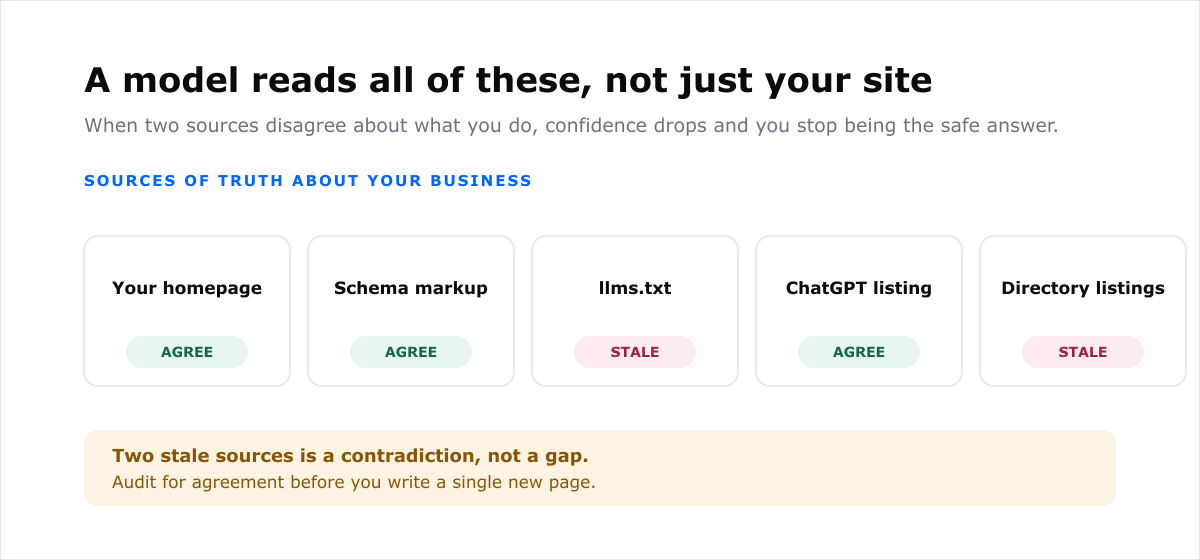
A model does not read your homepage in isolation. It reads your schema, your llms.txt if you publish one, your business listings, your directory profiles, and whatever third parties say. When two of those disagree about what you do, the sensible behaviour is to hedge, and a hedged answer is one where you are mentioned rather than recommended.
The audit is tedious and fast. Put your one-line description from each source in a single document and read them together.
- Homepage hero and meta description
Organizationschema description and sloganllms.txt, if you publish one. Note that if a plugin generates it, it may be stale relative to the database- Your ChatGPT business listing and Google Business Profile
- LinkedIn, Crunchbase, and any directory you have ever been added to
Pass: a stranger reading all of them would describe your business the same way every time. Not identical wording, the same meaning.
We found two stale sources on our own site doing exactly this exercise: an old positioning line surviving in the schema slogan after the site copy had moved on, and a generated llms.txt still serving descriptions we had replaced in the database weeks earlier.
Layer 5: can you tell whether any of it worked?
An audit that ends with a list of fixes and no instrumentation produces an argument in three months, not an outcome.
Decide what you will watch before you change anything.
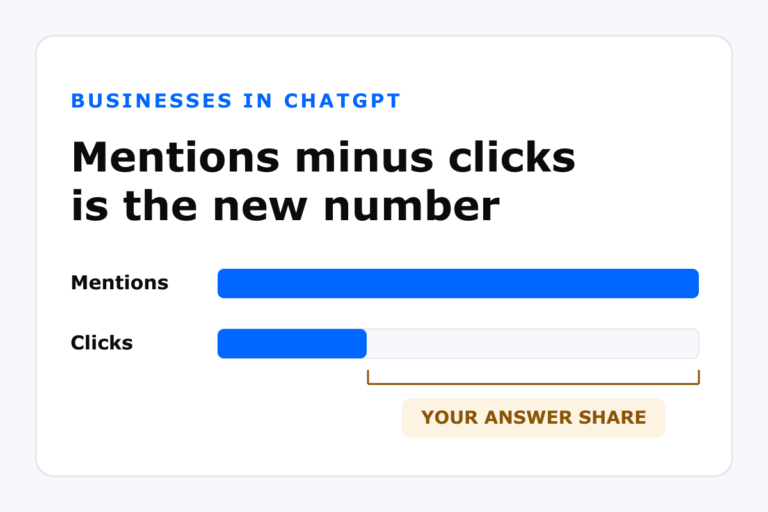
- Record a baseline. Mentions and clicks from your ChatGPT business listing if you have claimed one, branded impressions in Search Console, and direct traffic.
- Segment branded from generic in GA4, so a lift in brand-led traffic is visible rather than buried in an organic total.
- Change one layer at a time. If you fix entity resolution, schema and page structure in the same sprint, you will not know which one moved the number.
- Allow for lag. A mention today can surface as a branded search weeks later. Judging AI search on same-session clicks makes it look useless.
If branded and generic traffic are not cleanly separated in your analytics, that is the first fix, not the last. It is the same groundwork as the data layer playbook, and it is what makes everything above this line measurable instead of asserted.
Score it
Run each layer and mark it pass, partial, or fail. The lowest failing layer is where your next sprint goes, regardless of what the layers above it look like.
| Layer | The question | If it fails, you get |
|---|---|---|
| 1. | ||
| 2. Describe | Does it have category, geography, audience, price? | Vague answers and no recommendation |
| 3. | ||
| 4. Agree | Do your sources say the same thing? | Hedged answers, mentioned but not trusted |
| 5. Measure | Can you prove a change worked? | A budget argument you lose next quarter |
The three failures we see most
Publishing before resolving
A team ships twenty articles while their schema still carries a description from a positioning exercise two years old. The content is fine. The entity is muddled, so the content accrues to a company the model is not sure exists.
Optimising for a keyword instead of a question
Pages built around a search phrase often answer nothing cleanly. Assistants are asked questions, not phrases, and a page that never states an answer in one place is hard to quote. This is the most common finding in a technical SEO review that has AI visibility in scope.
Treating absence as a content gap
When a brand is not cited, the reflex is to write more. Often the real cause is layer 1 or layer 4, and more publishing makes the contradiction louder rather than resolving it. Audit before you commission.
- Run the three-assistant test first: same four questions, logged out, answers side by side
- Audit bottom-up, because each layer depends on the one below it
- Entity resolution fails quietly, and no amount of content fixes it
- Four facts decide recommendations: category, geography, audience, price
- Price is the one most sites omit and the one that qualifies you
- Contradiction between your own sources costs more than thin content
- Baseline before you change anything, and change one layer at a time
We run the five layers, score each one, and hand back the findings in priority order with the measurement set up so you can prove what moved.
See how AI-first SEO works