Overview
A SaaS scheduling and workforce-automation platform came to us with a clear problem: traffic to the site was stable, but product signups and demo requests were not growing. The product was solid and the market was there, yet the site was not turning visitors into pipeline.
The brief was to build a product-led growth engine: rank for the problems buyers actually search for, position the product around outcomes, and remove the friction between a first visit and a booked demo.
The challenge
Low organic signups
Traffic was steady but few visitors started a signup, and use-case pages neither ranked well nor clearly connected to real scheduling problems.
Weak product positioning
Hero messaging focused on features rather than outcomes, with no clear call-out for the core ICPs, operations leaders and service-based founders.
No product-led SEO framework
There were no workflow or job-to-be-done pages targeting real scheduling scenarios, and limited coverage of problem and comparison keywords.
Limited behavioural insight
Event tracking in GA4 and Mixpanel was incomplete, so there was no clear funnel view from landing page to pricing to demo.
A leaky demo page
The demo form was long and high-friction, and CTAs sat below the fold or competed for attention.
Our approach
We ran a Design Thinking diagnostic to learn what buyers were really searching for and where the funnel lost them.
- 1
Empathise
interviewed power users and customer success teams to map real scheduling pain.
- 2
Define
fixed the primary ICPs: operations managers and service-based founders.
- 3
Ideate
created a new SEO architecture, outcome-based messaging and demo-flow concepts.
- 4
Prototype
built updated versions of the homepage, use-case pages and pricing page.
- 5
Test
A/B tested hero statements, CTA placement and demo-form length.
What we did
Built a product-led SEO architecture. We created workflow and job-to-be-done pages around real scheduling problems, missed shifts, manual rotas and coordination, and expanded problem and comparison keyword coverage, which grew bottom-funnel organic traffic by 82%.
Repositioned around outcomes. Hero messaging moved from features to outcomes, with clear call-outs for operations leaders and service-based founders so each buyer saw their own problem answered.
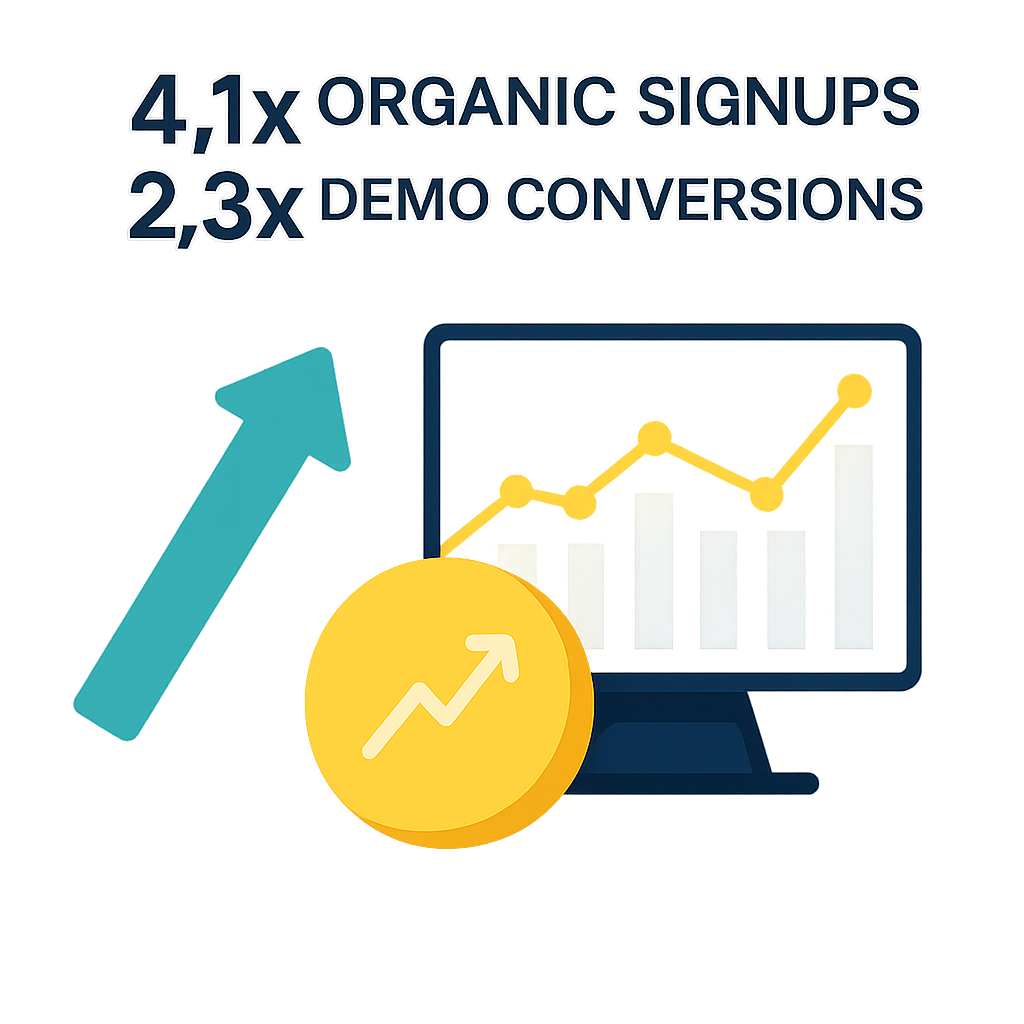
Removed friction from the demo path. We shortened the demo form, moved CTAs above the fold and cleared competing actions, lifting demo conversions 2.3x.
Completed the analytics layer. GA4, Google Tag Manager and Mixpanel were rebuilt for full event tracking from landing page to pricing to demo, so the team could see and fix drop-off. Together the work grew organic signups 4.1x.
The impact
- A predictable, scalable organic pipeline of signups and demos.
- Higher demo quality and better sales-team efficiency.
- Lower acquisition costs from a stronger organic contribution.
- A reusable product-led SEO and UX framework for new features and verticals.
- Stronger alignment between product, marketing and sales.
“Prospects were not searching for scheduling software. They were searching for solutions to missed shifts, manual rotas and coordination headaches. Ranking for those intents changed the funnel.”